Celebrations
söndag 12 februari 2023

Careful Where You Point That Thing!
Illustration by John Sauer – johnsauer.com
https://fohonline.com/articles/foh-at-large/careful-where-you-point-that-thing/
Back in 2005, I wrote about how the use of the Long-Range Acoustic Device (LRAD) was used to repel Somali pirates who were attacking a cruise ship. Sonic weapons are deployed by the military and described as non-lethal, although that may not be true depending upon the amount of time of the recipient is exposed. These sound cannons have been in use by the military and have also been used by local city police forces as well. These devices can project a voice or recording up to three hundred yards as well as incapacitating a person with excruciating levels of audio signal (about 160 dB at full force). These cannons can also immobilize an unlucky victim in a more visceral way with lower frequencies. In fact, New York City has been sued by protesters, journalists and bystanders who objected to the sound cannon’s use as excessive force, while in Pittsburgh, a bystander suffered permanent hearing loss from an LRAD attack in 2009 and was awarded $72,000. The use of LRADs has also been associated with dizziness and migraines for those who have been exposed.
‡‡ I Hear Voices…
As a communications system, LRAD has been used by Navy destroyers to communicate with small ships at great distances by aiming it at one of the crewmembers and speaking directly to them. The Navy crewmen transmitting these focused sounds often noticed how frightened the recipient was at receiving these personal messages even after realizing that it was coming from the Navy ship. Then, not being one to pass on a devilish idea, the military brass supposedly created a new weapon that could make people believe that they were hearing voices in their heads. I say supposedly, as no one in the military is actually admitting to possessing the weapon, but there are rumors that it is being used to convince Islamic terrorists to surrender by putting the word of God into the heads.
In 2013, at the Washington Navy Yard, Navy reservist Aaron Alexis went on a spree and killed 12 people before being killed in a shootout with police. Apparently, before the rampage, he had complained to friends about hearing voices and receiving vibrations from a microwave machine. It seems that “hearing voices” is a common thread running through the psychology of serial killers, but the fact that this event took place on a military base and a microwave machine was mentioned makes one wonder. During World War II, there were reports by those working near radar transponders of hearing clicks and even speech directly inside their heads. In 1961, neuroscientist Allan H. Frey published his “Human Auditory System Response to Modulated Electromagnetic Energy” in the Journal of Physiology, which described his studies and experiments with the microwave auditory effect (MAE), which has now become known as the Frey Effect.
‡‡ Brain Drain
In 1975, there were successful experiments with voice modulated microwaves, but the conclusion derived from the experiments was that this would be an impractical tool since the radiation from the high-power microwave transmission would cause brain damage. This, of course, brings to mind the recent attacks on diplomats in Cuba and China where it was concluded that the symptoms experienced by these government workers were most likely caused by directed microwave radiation. That said, the frequencies of the brain have been mapped with Beta at 12-35 Hz, which is active; Alpha from 8-12 Hz, which is very relaxed; Theta 4-8 Hz, deeply relaxed; and Delta 0.5-4 Hz, corresponding to sleep. Of course, there is no point in mapping the frequencies of the brain unless the technology can be put to use and sure enough, by beaming powerful pulses of electromagnetic radiation into the brain a scientist can roadblock or stimulate these specific circuits of the brain.
The use of ultrasonic waves to create beams of sound was being explored in the 1960s by the U.S. Navy and its Soviet counterpart, but this technology wasn’t available until the early 2000s, when “Holosonic Research Labs” — a company formed by F. Joseph Pompei of MIT — commercially released its “Audio Spotlight,” which is a narrow beam of sound that can be controlled in much the same way as the light from a spotlight. Of course, this technology seems to be similar to the technology used in LRAD, albeit in a more benign form; as in tradeshows, museums, hospitals and retail to name a few. My understanding is that if someone should walk across the beam of sound, the beam can be broken in the same way as a beam of light. Therefore, it seems that the best applications for this technology are with the spotlight speakers placed directly above the listener and not at an angle directed to the listener. Since our audio focus is directed towards delivering a band’s sound to a large audience, this pretty much removes this technology from our world of concert touring, but while we won’t be employing LRAD or Audio Spotlights, there is a new innovation that has piqued my interest.
‡‡ Feed Your Head
An Israeli company by the name of Noveto announced its newly released SoundBeamer 1.0, a commercial product that beams sound directly into the listener’s head. Well, not actually into the head, but directly to the listener’s ears without the use of headphones. It can even follow the listener as they move their head around by using a sensing module that sends 3D audio via ultrasonic waves. These ultrasonic waves create pockets surrounding the listener’s ears that only they can hear. The sound beam can also be fixed, allowing the listener to walk in and out of the beam.
‡‡ An Onstage Solution
While this commercially new sound beaming technology is being explored and developed for Augmented Reality and Virtual Reality applications, one can easily envision the day when the technology can be used in a live concert situation, replacing in ear monitors with beaming monitors. After all, the technology has been in use by the military for about 20 years, which is about the right amount of time before release for public consumption. As a multi-purpose tool, just think what a boon this could be for sound and security if a fan rushes the stage. The monitor engineer can turn the sound beam into an LRAD and incapacitate the unruly fan without disrupting the show, or in a really suave move, the engineer could hit the fan with the voice of God and threaten to smite them for their trespass if they do not immediately leave the stage.
lördag 9 april 2022
Isat - Inmarsat
Innovative Space-based Radar Antenna Technology
 ISAT computer model | |
| Mission type | Technology demonstration |
|---|---|
| Operator | AFRL, DARPA, STP |
| Spacecraft properties | |
| Spacecraft | ISAT |
| Manufacturer | Boeing, Lockheed Martin |
| Dimensions | Antena: 300 m (980 ft) |
| Start of mission | |
| Launch date | 25 June 2019 |
| Rocket | Falcon Heavy[1] |
| Launch site | KSC LC-39A |
| Contractor | SpaceX |
| Orbital parameters | |
| Reference system | Geocentric |
| Regime | Low Earth |
ISAT (Innovative Space-based radar Antenna Technology) is a spacecraft developed by the U.S. Air Force Research Laboratory's Space Vehicles Directorate to test technology for intelligence, surveillance, and reconnaissance spacecraft.[2]
The ISAT program is developing technologies that enable the deployment of extremely large electronically scanning antennas in space, and the metrology and calibration technologies necessary for coherent beamforming from such large antennas. These huge antennas enable the revolutionary performance required to conduct tactical sensing from space, including missions like continuous reliable tracking of surface targets.[3]
https://en.wikipedia.org/wiki/Innovative_Space-based_Radar_Antenna_Technology
GomSpace Sweden
GomSpace to Ship Propulsion Systems to Astrocast
By Annamarie Nyirady | July 13, 2018
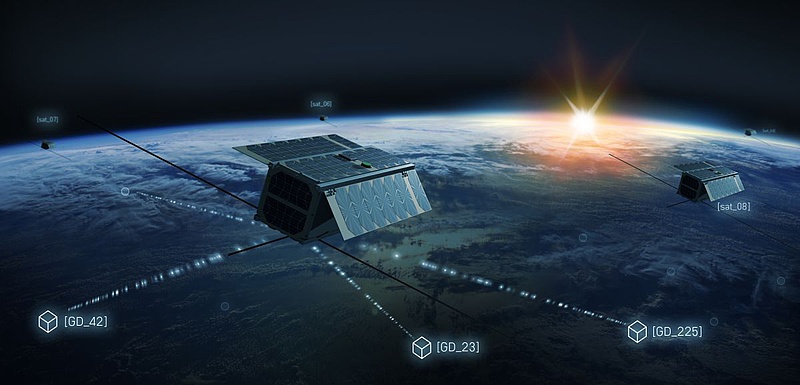
Astrocast satellite network. Photo: Astrocast
GomSpace Sweden signed a contract with Astrocast, a Swiss nanosatellites provider, to deliver a propulsion system for each of the 10 nanosatellites in the first orbital plane of the new Astrocast constellation. This will be the first propulsion system operating on a constellation of 3U cubsesats.
The contract is a follow-on order to the delivery of propulsions systems for the two precursor satellites, which will be launched this fall. The system will allow Astrocast to more rapidly deploy each satellite to its intended position and will assist in collision avoidance maneuvers.
Astrocast has been deploying nanosatellites to create a global Internet of Things (IOT) network. The order is valued at 450,000 euros and the propulsion systems will be delivered in Q4 2018 and Q1 2019.
Via satellite
onsdag 30 juni 2021
Navstar GPS
The satellites transmit ranging signals on two D-band frequencies: Link 1 (Ll ) at 1575.42 MHz and Link 2 (L2) at 1227.6 MHz. The satellite signals are transmitted using spread-spectrum techniques, employing two different ranging codes as spreading fictions, a 1.023 MHz coarse/acquisition code (C/A-code) on L1 and a 10.23 MHz precision code (P-code) on both L1 and L2. Either the C/A-code or the P-code can be used to determine the range between the satellite and the user, however, the P-code is normally encrypted and available only to authorized users. When encrypted, the P-code is known as the Y-code. A 50 Hz navigation message is superimposed on both the P(Y) -code and the C/A-code. The navigation message includes satellite clock-bias data, satellite ephemeris (precise orbital) data for the transmitting satellite, ionospheric signal-propagation correction data, and satellite almanac (coarse orbital) data for the entire constellation. Refer to paragraph 1.4 for additional details regarding the ranging codes and navigation message.
onsdag 10 februari 2021
Telepathhero and Networth : $1444 billions artificially value
Biometric data and thought
Number of thought and days (Day + Night)
3139 + 4469 days =7608 days between 2000 - 2020 today
Ca 542318760 + 656406720 = 1198725480 thougt
Every thought worth 10000 SEK or 1204.81927711 USD
Networth:
1198725480 (thought) * 10000 (SEK) = 1.19872548e13 SEK
11987254800000 (SEK) / 8.3 (USD) = 1.44424756627e12 USD (artificially value)
$1444 billions = 1.444 Trillions
lördag 14 november 2020
About Rambo Microchip and Mark of the Beast
https://paranormalis.com/threads/mark-of-the-beast-marc-multiple-automated-readout-computer-chip.3564/
Some explenation
About Rambo Microchip and Mark of the Beast
Multiple Automated Readout Computer Chip (MARCC)
in u.s.
B.E.A.S.T. which stands for Battle Engagement Arena Simulation and Tracking
in eurpoe brussel
In Belgium (Brussels) is the BEAST (Beast) - Biometric Encryption And Satellite Tracking, 'Mark of the Beast'
MARK = MARC = M.A.R.C.C. = Multiple Automated Readout Computer Chip
BEAST = B.E.A.S.T. = Battle Engagement Area Simulation and Tracking
The military super computers, since the
1970s, go by the acronym B.E.A.S.T. which stands for Battle Engagement Arena
Simulation and Tracking. GI's are now tagged with a tracking chip called the
Multiple Automated Readout Computer Chip (MARCC).
10. Military computers developed at AREA 51, are said to be using HUMAN DNA, specifically brain cells stretched across the computer chips, making them as fast as the speed of thought.
1) "The US Government has a computer named B.E.A.S.T. (Battle Engagement Area Simulation and Tracking), developed out of Area 51. It uplinks to a satellite using GPS. They power a Diode in a computer chip called M.A.R.C. (Multiple Automated Readout Chip), which is best placed in the hand or forehead because of lowest body temperature. I don't put any stock in the view that this is from prophesy, however, this is an interesting choice of terms used by our government for such a system.
Prenumerera på:
Inlägg (Atom)