Back in January 2015, I gave a talk about MEMS loudspeakers at the ALMA International (now named Audio and Loudspeaker Technologies International or ALTI) Expo, and I have regularly written about MEMS (microelectromechanical systems) speaker progress. A half decade later, it seems we are finally now moving beyond the industry's joke that MEMS’ development progress can be measured in dog years - it takes 7 human years for each year of MEMS’ progress!
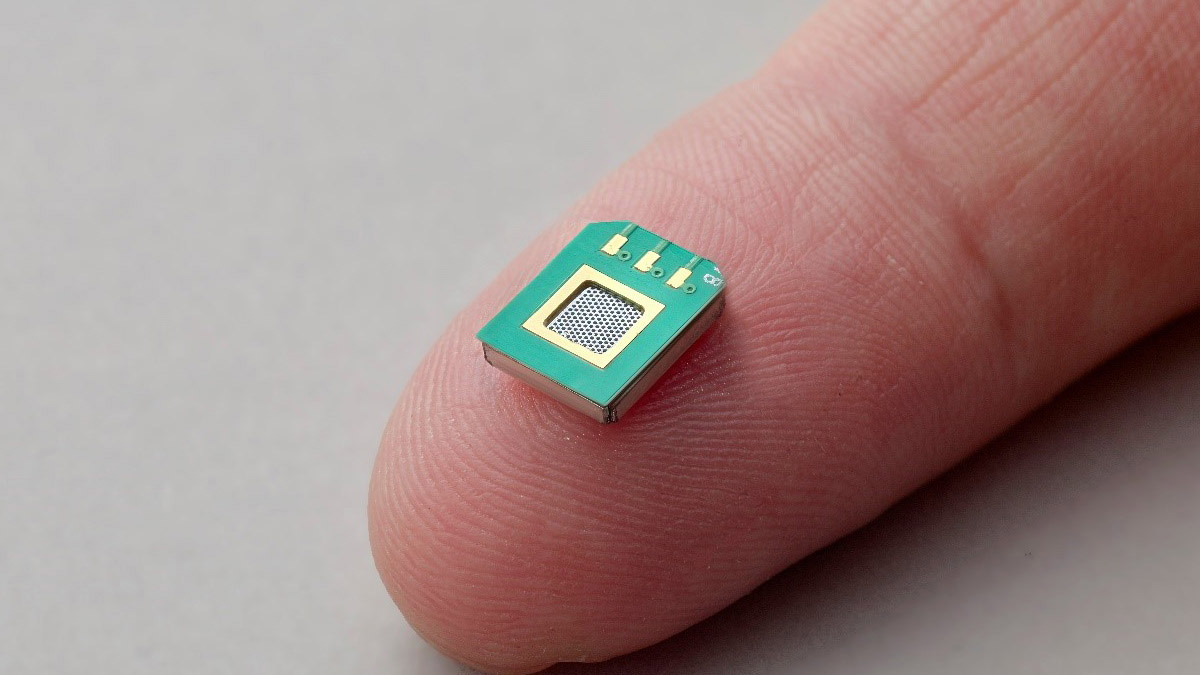
MEMS’ microphone development over the first decade was painful. However, MEMS mics became practical when they could be manufactured with high yields using integrated circuit (IC) fabrication and device packaging processes. Today, MEMS devices include microphones, accelerometers, vibration/shock sensors (e.g., burglar alarms and airbag sensors), gyros and now µSpeakers and earphone transducers. And different types of MEMS microspeakers are now entering production.
It took more than 20 years for the first billion MEMS microphones, and two years for the second billion’s production, compared with monthly production now reaching about 1 billion units. Today, MEMS microphones totally dominate smartphones, tablets, laptops, portable media players, speech recognition systems, personal computers, surveillance cameras, 3D cameras, radars, anti-theft alarms, headphones, smart speakers, music recorders, and various smart home voice command appliances, including air conditioners, refrigerators, and service robots. Compared to microphones, the implementation of Piezo-MEMS in microspeakers is daunting, due to the far higher excursion requirements.
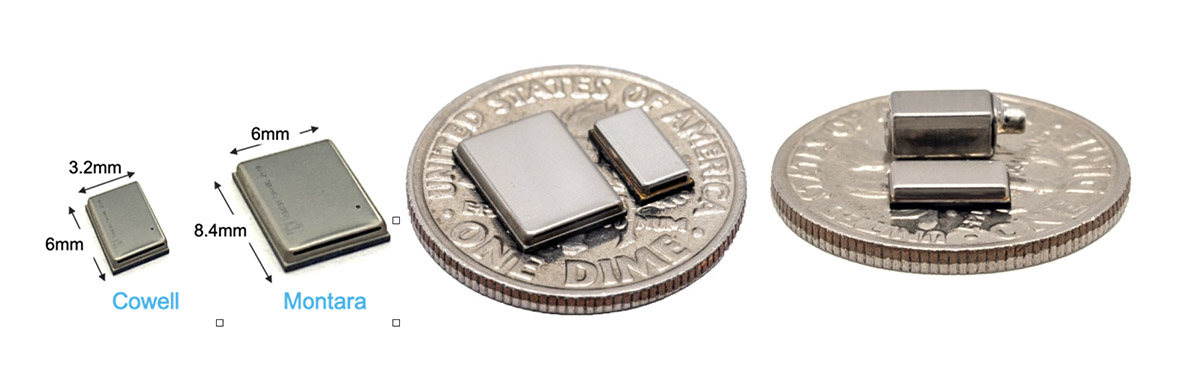
xMEMS has partnered with TSMC for mass production of its Montara monolithic piezo-MEMS microspeaker and has now confirmed the availability of Cowell, a second-generation ultra-small form factor full-range driver, measuring just 3.2mm x 1.15mm.
The big news is xMEMS Labs, a company founded in January 2018 and headquartered in Santa Clara, CA (click here for more insights), has announced it is now in mass production of its Montara, a monolithic MEMS “µspeaker” with a slim 1mm profile, already on its way to market. xMEMS now has 36 granted patents and more than 100 patents pending for its technology.
As audioXpress reported recently, xMEMS’ Taiwan fabrication partner, TSMC, is the world's largest semiconductor foundry (and partner for Apple's new SoC and SiP processors, found in AirPods, iPhones, iPads and MacBooks). Montara’s initial 1st tier design win is with Inventec Appliances Corp. (IAC), which selected it for the company’s flagship Chiline TR-X TWS Earbuds, powered by xMEMS Aptos, a Piezo-MEMS audio driver IC.
The µSpeaker and earphone driver market is valued at about $10 billion annually. Just considering the work needed to shift production lines, even automated speaker production line manufacturing, over to semiconductor foundries, the impact could be mind boggling. The titans of µSpeaker manufacturing typically have about 50,000 employees, while MEMS foundries producing similar quantities of devices have staff of less than 500. Yes, the wafers from the foundry will still need to be “packaged” but a few zeros in workforce numbers would be still lobed off. With the rising cost of salaries in China, MEMS microspeakers will have a dramatic impact on staffing along with other far-reaching implications.
But it is not just the fabrication of the transducers, but the promise of automated pick-and-place of Piezo-MEMS µSpeaker for surface-mount technology (SMT) board stuffing - rather than hand soldering of billions of speakers - that is bound to create the most immediate impact.
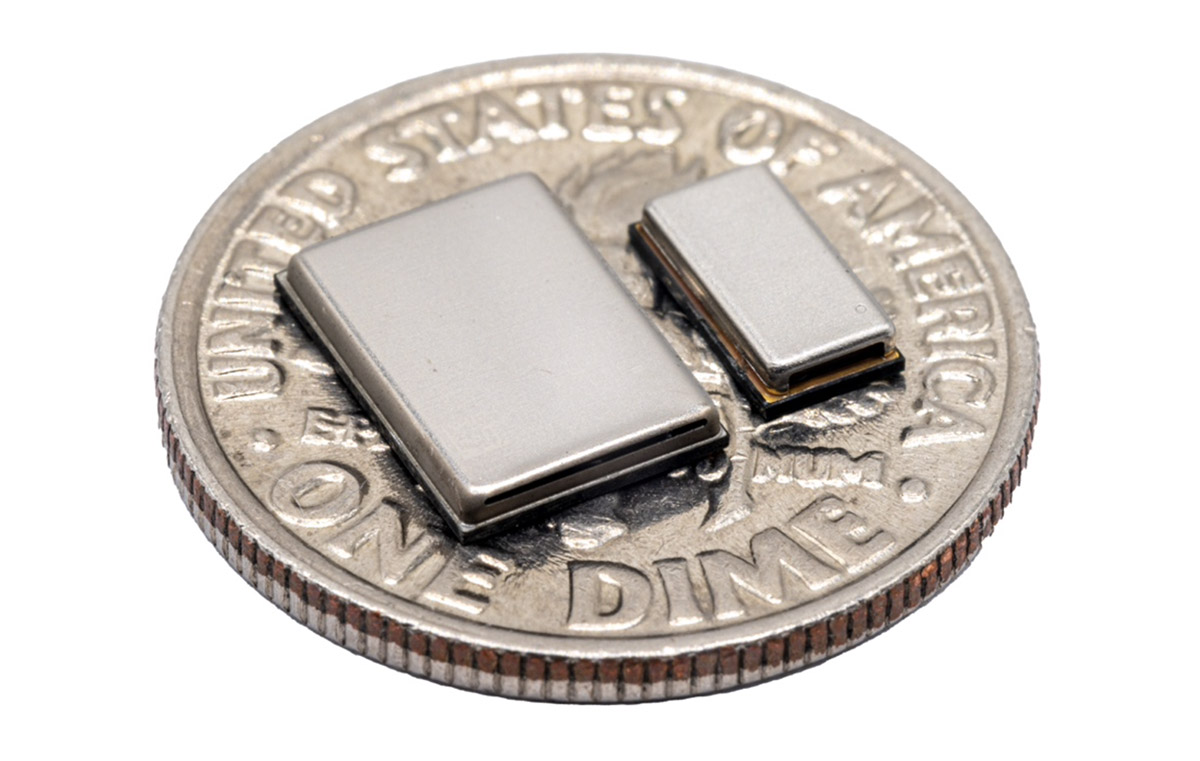
xMEMS introduced Cowell, the world’s smallest monolithic MEMS µspeaker, targeting the replacement of balanced armature drivers in true wireless earbuds and hearing aid designs.
There are quite a few steps in MEMS fabrication and getting high yields at every step always seemed to be another development phase away. Earlier-generation MEMS earphones and speakers were based on a two-step fabrication process where the “motor” was fabricated in a MEMS process, then sent for final assembly of the diaphragm/suspension into the package. The most recent generation of Piezo-MEMS earphone transducers are completely fabricated in the MEMS process resulting in a high yield, very tight uniformity, and the environmental robustness ideal for true wireless stereo (TWS) applications.
In full-range occluded (in-ear) applications, these transducers achieve smoother and more extended full-range response compared to balanced armatures. In two-way or higher designs with a dynamic “woofer” driver higher sensitivity is also achieved. Future smartphones will have ultra-wide band receivers and eventually MEMS for the hands-free speakerphone.
xMEMS’ Montara is the world’s first monolithic Piezo-MEMS µSpeaker. Monolithic, meaning the implementation of both actuation and diaphragm in silicon, resulting in superior part-to-part consistency in frequency response and phase. Montara’s fast mechanical response results in the industry’s lowest group delay and phase shift and can be seen in the smooth ultra-wideband response to beyond 70kHz. For manufacturers, these characteristics reduce calibration and speaker matching. The 1mm profile, SMT-ready package and IP58 rating for dust/water simplify system design, integration, and assembly.
All this makes piezo-MEMS microspeakers ideal receivers for over-the-counter (OTC) in-canal hearing aids and implantable hearing devices (cochlear and auditory brainstem implants). These applications have small “air pumping volume” required for adequate acoustic output due to the enclosed duct and close middle ear proximity.
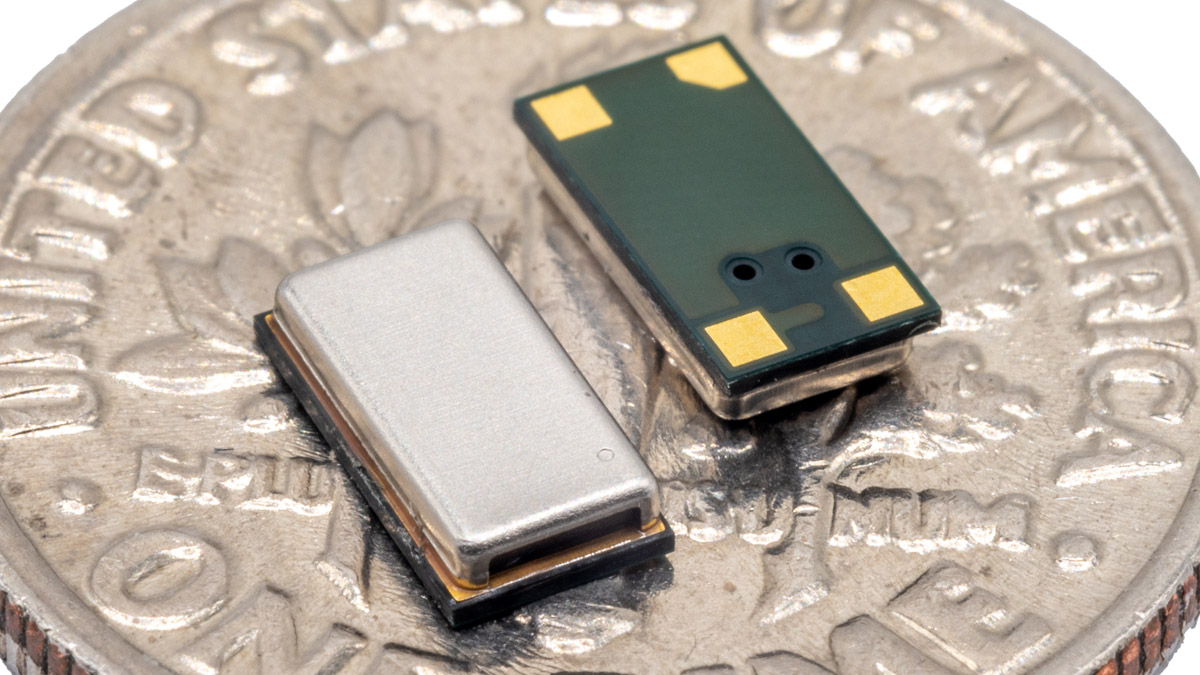
The side-firing Montara xMEMS microspeaker and the smaller side-firing Cowell in side by side comparisons. In the second "dime comparison" we can see Cowell side by side with an equivalent balanced armature receiver.
And There Is More... This week, xMEMS announced Cowell, the world’s smallest monolithic MEMS µSpeaker. At just 1.15mm high and 3.2mm wide, the Cowell side-firing package only weighs 56 milligrams and delivers an impressive 110dB SPL at 1kHz. Cowell provides up to 15dB of gain above 1kHz for improved speech-in-noise performance and greater vocal and instrumental clarity versus electrodynamic and balanced armature µSpeakers. This is also the first Piezo-MEMS to use xMEMS’ second generation M2 speaker cell architecture, offering improved SPL/mm2, enabling increased loudness in smaller form factors. And Cowell engineering samples are available now, with mass production in early Q2 2022.
Cowell’s attributes will enable designers of TWS hearables unique benefits in high-res audio and immersive sound, as well as OTC hearing aids. For TWS applications, Cowell can be implemented as a full-range driver in occluded earbud architectures or as a small, high-performance tweeter paired with an electrodynamic woofer driver in non-occluded or leaky two-way solutions.
For hearing aid applications, Cowell is a full-range driver that is 45% smaller than an equivalent balanced armature receiver, making receiver-in-canal applications possible. The driver's superior high-frequency response, lack of in-band resonance peaks, and 15dB of gain above 1kHz make it ideal for addressing high-frequency hearing loss and improving speech intelligibility in noise. Lastly, Cowell’s speaker diaphragm is vented (front-to-back), enabling the relief of air pressure that may build up over time inside the ear canal, resulting in reduced fatigue with increased long-term wear and listening comfort.
The side-firing package and 1mm-thin profile provides for placement flexibility in the earbud making space for larger batteries and additional sensor components. And the SMT-ready package boasts an IP58 rating for dust/water, simplifying system design, integration, and assembly.
xMEMS has samples and evaluation kits ready for companies working on new designs. For more information, visit www.xmems.com
This article was originally published in The Audio Voice newsletter (#351), November 2021.
ABOUT MIKE KLASCO
Mike Klasco is the president of Menlo Scientific, an audio consulting firm for the loudspeaker industry, located in Richmond, CA. He is a graduate from New York University, with post graduate work in signal processing, and he holds multiple patents licensed or assigned. For the past 35 years, since founding Menlo Scientific, he has worked on product development, design and technical support, liaison between suppliers and manufacturing facilities, sourcing guidance, and certification for a large number of companies. Mike specializes in materials and fabrication techniques to enhance audio performance, has over 500 articles published in audio magazines and technical journals, and to this day continues to be a regular contributor for audioXpress and Voice Coil magazines. He presented papers at the Acoustical Society of America, held positions as Session Organizer for the Audio Engineering Society, Chairman of the Committee on Acoustics, and is an AES Life Member.
SonicEdge MEMS Ultrasound Speaker-In-Chip: Next Gen MEMS for TWS Earbuds and Hearing Aids
February 24 2023, 00:00
As Monty Python once said, “And Now for Something Completely Different.” Ultrasonic MEMS Speakers!
Let’s start with the general speaker population. We characterize speakers by how they move air, more particularly their various types of motors and diaphragms.
The moving force can be electro-dynamic - the usual voice coil in a magnetic structure driving a cone or dome - or a planar film diaphragm with laminated conductor pattern in a magnetic field. Oskar Heil’s air motion transformer (AMT) features an accordion-pleated diaphragm using the squeezing of the pleats to move air, but otherwise similar to tensioned diaphragm magnetic planars. One recent reincarnation of the AMT, (sort of, on a microscale) could be the Arioso MEMS speaker, which uses electrostatic actuators integrated inside 20µm wide bending strips, which are energized by vibrations from the audio signal voltage. Arioso Systems was recently acquired by Bosch.
Another more esoteric approach are electrostatic planars, which use a metalized diaphragm between grids. Microelectromechanical systems (MEMS) speakers are a new crop, mostly in that their acoustic production can be capacitive or piezo-electric as the driving force for the diaphragm. Admittedly I have given all these the short shift and each has enough variants to fill a book.
Now we move on to another universe of transducers that do not quite follow the usual rules of acoustic production. These are the modulated and parametric speakers that have been proposed and are now moving through development.
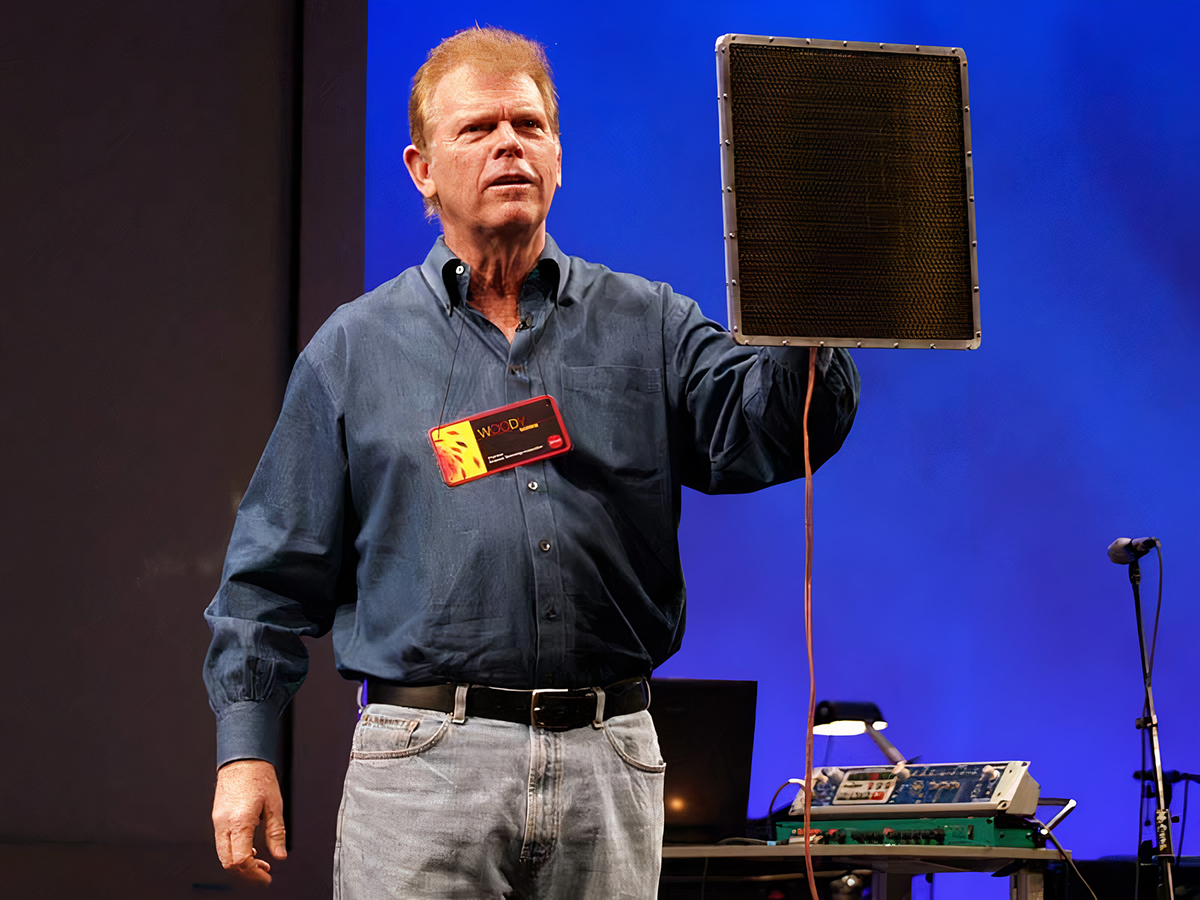
Perhaps you might remember back to 2009 to Woody Norris and his Hypersonic Sound Speaker (HSS). These were a class of ultrasound transducers that generated audible sound from modulated ultrasound. The modulated ultrasound passes through a nonlinear medium that acts as a demodulator. Projecting a narrow beam of modulated ultrasound substantially changes the speed of sound in the air that it passes through. The air within the beam behaves nonlinearly and extracts the modulation signal from the ultrasound, resulting in sound that can be heard only along the path of the beam, or that appears to radiate from any surface that the beam strikes.
Click to see the video with Woody Norris’ presentation of the Hypersonic Sound Speaker
Basically, the heterodyne speaker uses ultrasonic modulators of two beams with the difference creating the audio. This technology allows a beam of sound to be heard only in a small well-defined area; for a listener outside the beam the sound pressure decreases substantially.
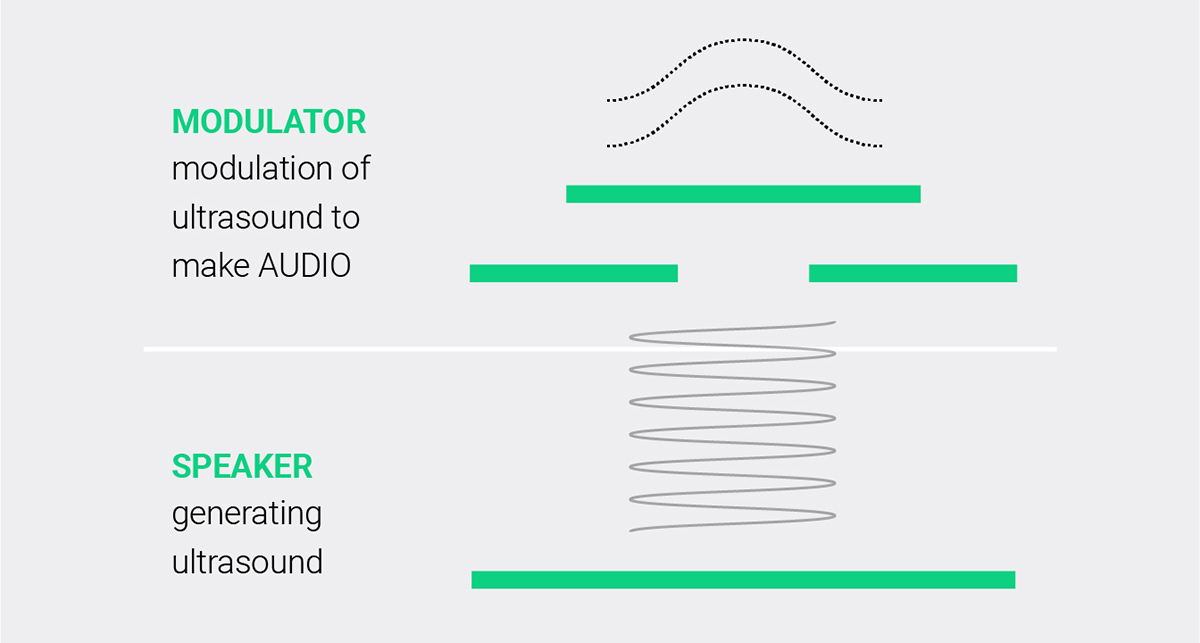
And Now... A Unique Ultrasonic Shutter MEMS-Based Speaker System Percolating in stealth mode for a decade is the work of Moti Margalit, CEO, and Ari Mizrachi (COO) of SonicEdge, today leading a growing team, including some in their Danish subsidiary. The core of the design is one or more apertures driven by the ultrasonic carrier signal and one or more movable and over-sized obstruction elements that are configured to modulate the ultrasonic carrier signal (think of a shutter) thereby generating audio.
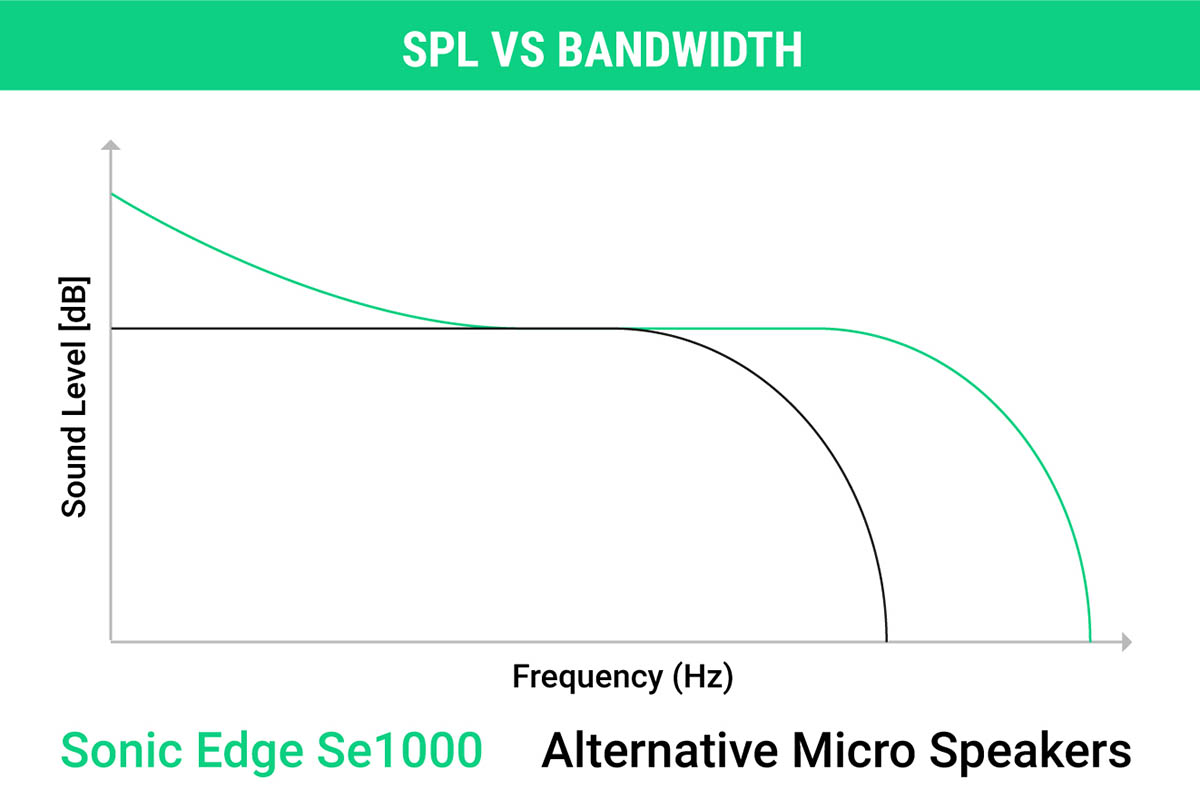
The ultrasound propagates through a time varying acoustic channel, which is an acoustic modulator. A large channel enables the ultrasound to pass, and a small channel attenuates the ultrasound. The modulator shifts shifting the ultrasound frequency creates a constant volume velocity source. A standard speaker in earphone applications has a constant sound level for lower frequencies and drops short at higher frequencies (black line). A volume velocity source provides a constant volume velocity of air regardless of frequency and in earphone applications has increasing SPL for lower frequencies and extended SPL at high frequencies (green line).
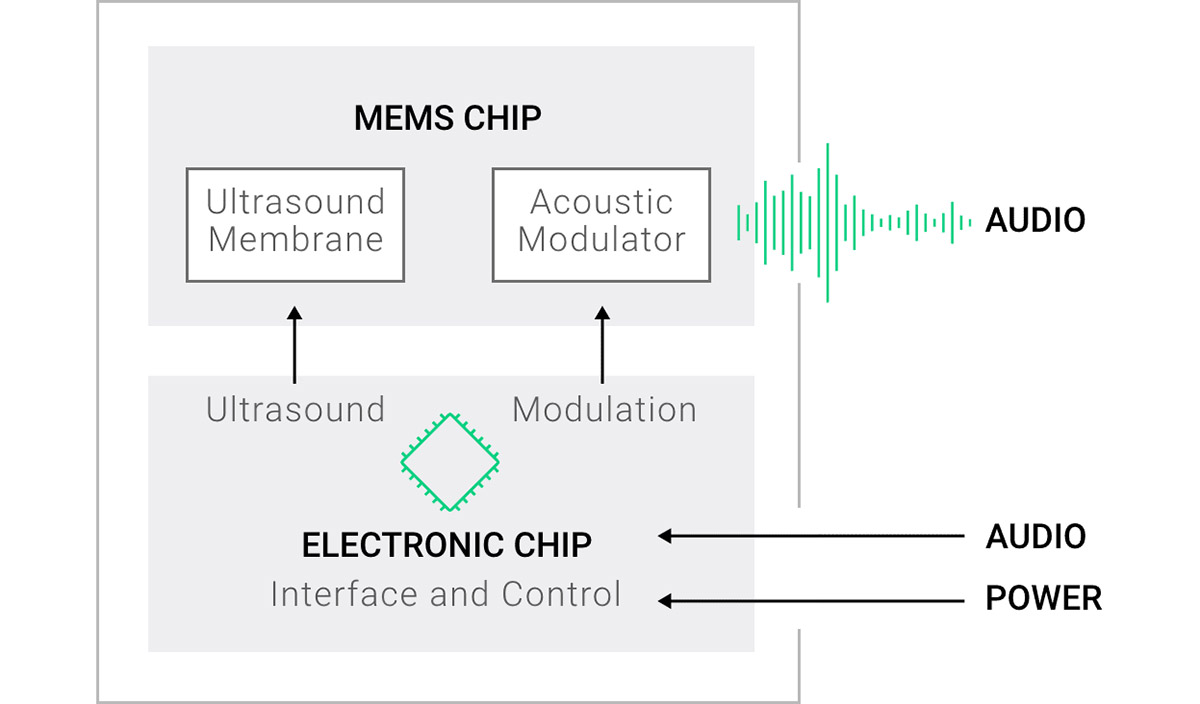
As can be seen from the graphs, this technique overcomes the challenge of large excursion and piston size in MEMS speakers by using a radically new approach based on active modulation of ultrasound. The SonicEdge speaker is composed of membranes generating modulated ultrasound and acousto-mechanical demodulators that frequency shift the ultrasound to audio.
The MEMS speaker is based on existing process modules for ultrasound transducers, such as Capacitive Micromachined Ultrasound Transducers (CMUT) or Piezoelectric Micromachined Ultrasonic Transducers (PMUTs).
The resulting game-changing speaker is a constant volume velocity source, generating-resonance free audio and ideally suited for non-occluded earphones and headsets with ANC functionality.
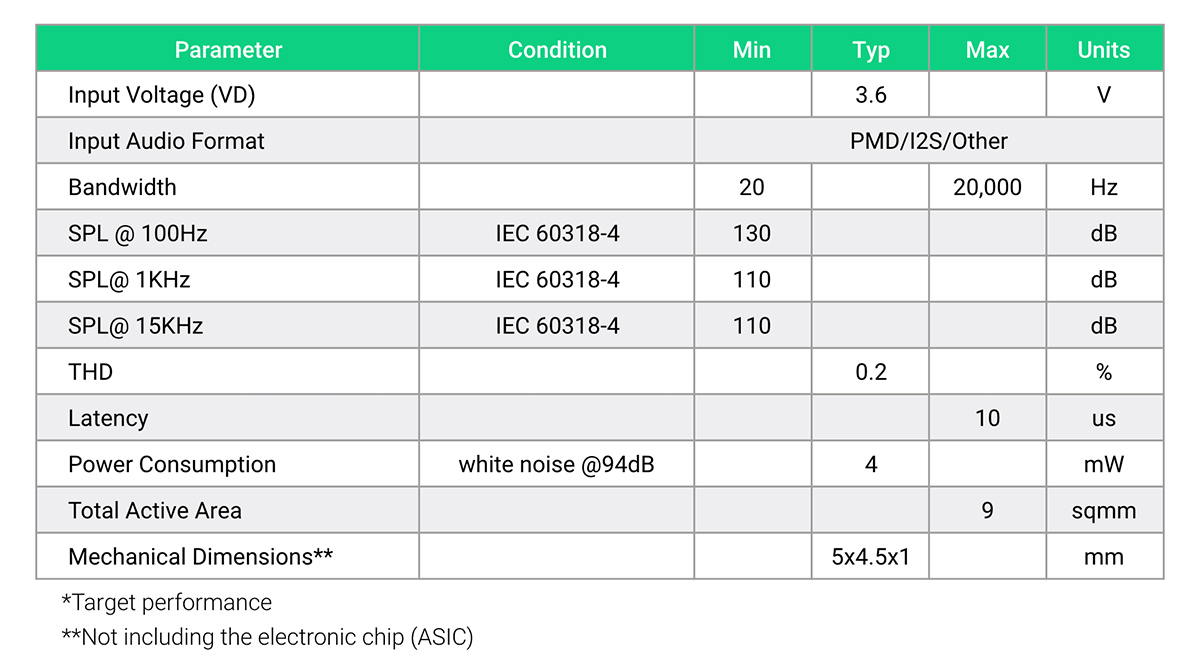
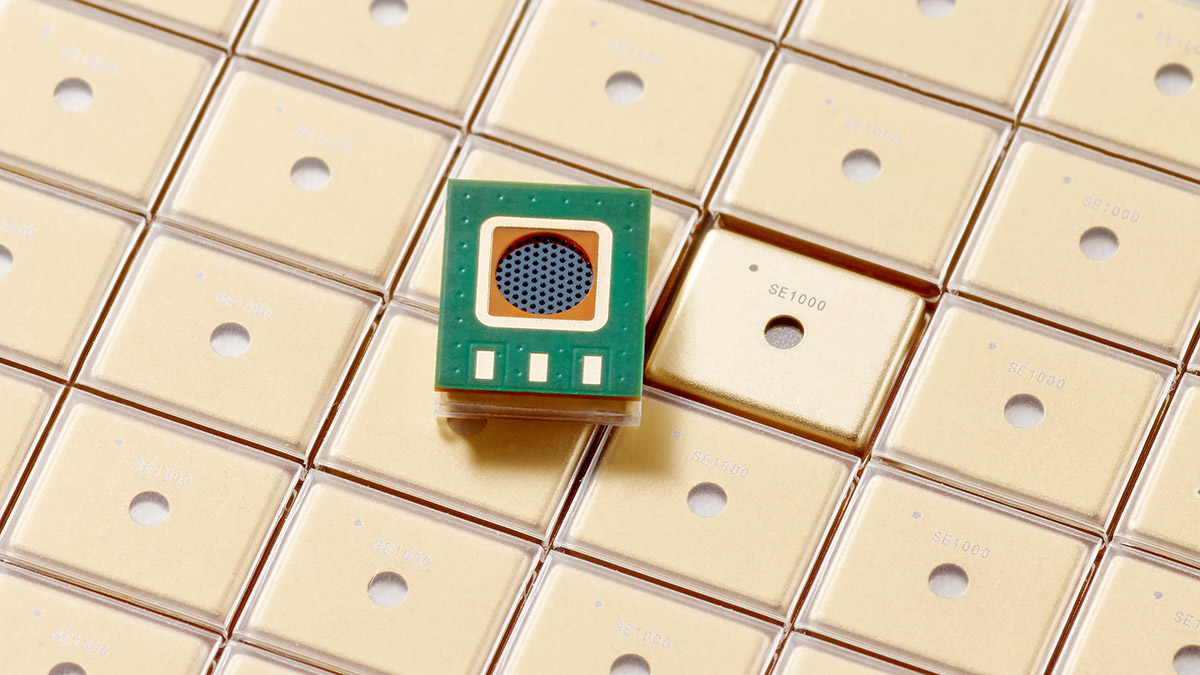
The company's SE1000 solution includes the MEMS speaker chip that generates sound combined with an ASIC that drives the transducer.
Back in 2018 I first came across this technology in my consulting work and some of the many patentsthat belong to SonicEdge. Since then, work has continued and SonicEdge was formed to complete development of the concept. Around this time last year SonicEdge emerged from “stealth mode” and first appeared in the MEMS microspeaker directory published in Voice Coil May 2022. Currently, SonicEdge is conducting POC projects with an evaluation board for strategic customers, with commercial availability of its first MEMS speaker (SE1000), anticipated for later in 2023 (specifications below).
This ultrasound nano-speaker and frequency transformers are realized as a solid-state MEMS device manufactured monolithically leveraging the semiconductor eco system for scalability and price trajectory. Coming from the semiconductor fab as a final device in minimal size, which includes a MEMS chip that generates sound and an ASIC amplifier chip that drives the MEMS chip, SonicEdge has developed a unique technology that generates ultrasound from multiple acoustic pixels, each as wide as a strand of hair. The back cavity is 10x reduced in size compared to state-of-the-art 11mm drivers and therefore supports new design paradigms for earphones. The lack of a magnetic structure also relieves the TWS pain-point of providing enough separation between the antenna and the transducer.
There are advantages in size and sound quality, no mechanical vibrations, potentially low power consumption, and more SPL than what some of the earlier MEMS speaker efforts. The minuscule vibration produced with this sound product technique enables a lot more acoustic echo cancelation (AEC) and feedback margin in applications such as TWS and hearing aids, along with full-duplex speaker-as-mic functionality, together with some other sensing capabilities.
Having taken a good listen at CES this year, the device sounded excellent, as did some of the other recent MEMS earphones. SonicEdge’s product roadmap also includes bass reflex acoustic design supporting full-range free-field speakers for AR/VR and mobile device applications.
SonicEdge developed a unique technology that generates ultrasound from multiple microtransducers, and then transforms the ultrasound to human-audible sound using a patented acousto-mechanical frequency transformer or acoustic modulator, contained on a solid-state MEMS device.
This article was originally published in The Audio Voice newsletter, (#411), February 23, 2023.
ABOUT MIKE KLASCO
Mike Klasco is the president of Menlo Scientific, an audio consulting firm for the loudspeaker industry, located in Richmond, CA. He is a graduate from New York University, with post graduate work in signal processing, and he holds multiple patents licensed or assigned. For the past 35 years, since founding Menlo Scientific, he has worked on product development, design and technical support, liaison between suppliers and manufacturing facilities, sourcing guidance, and certification for a large number of companies. Mike specializes in materials and fabrication techniques to enhance audio performance, has over 500 articles published in audio magazines and technical journals, and to this day continues to be a regular contributor for audioXpress and Voice Coil magazines. He presented papers at the Acoustical Society of America, held positions as Session Organizer for the Audio Engineering Society, Chairman of the Committee on Acoustics, and is an AES Life Member.
At The Association of Loudspeaker Manufacturing & Acoustics (ALMA) International in January 2015, I gave a talk on microelectromechanical systems (MEMS) loudspeakers, and quite a few inquiries followed. As a follow up to last month’s focus on microspeakers, we thought it might be time for an article on MEMS microspeakers. This is really new technology, so new that only recently were functional lab prototypes operational.
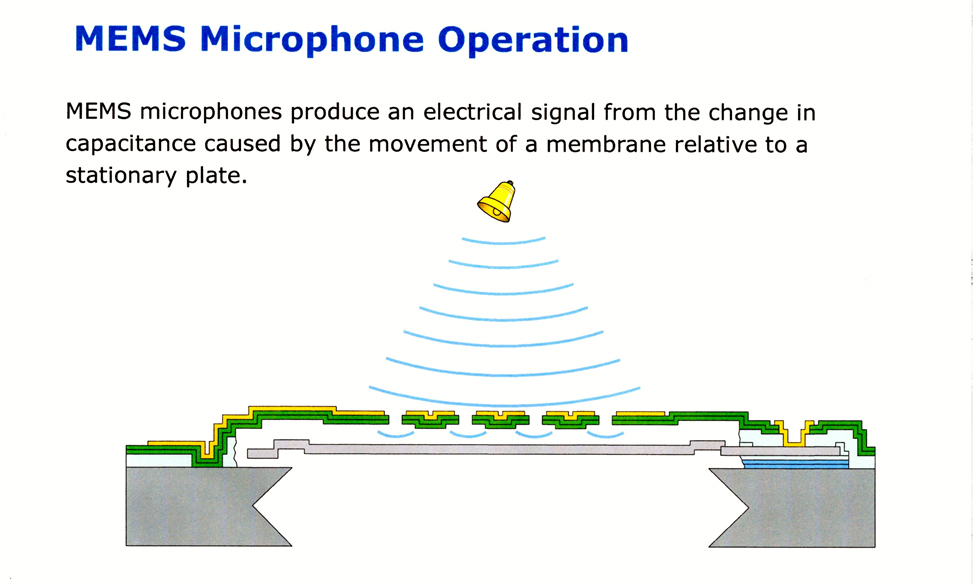
Photo 1: This diagram illustrates how a MEMS microphone chip operates. (Image courtesy of STMicroelectronics)
MEMS is the technology of very small devices, usually consisting of a micro-sensor/transducer and an application-specific integrated circuit (ASIC) that processes data (e.g., codec functions and amplification). We will examine MEMS devices in general, provide a basic explanation of how a MEMS speaker works, and what commercialization challenges are ahead. When MEMS speakers are viable commercial products, we will also need to consider their practical applications, projected unit costs, and acoustical strengths and weaknesses.
A Bit of MEMS History MEMS development over the last three decades has been slow and painful. The semiconductor industry’s favorite joke regarding MEMS development schedules are that they are calculated in dog years (seven times that of human years). However, MEMS devices became practical when they could be manufactured using integrated circuit (IC) fabrication and device packaging processes (see Photo 1). MEMS mainstream consumer electronics devices include accelerometers, vibration sensors (e.g., burglar alarms and air bag sensors), and microphones.
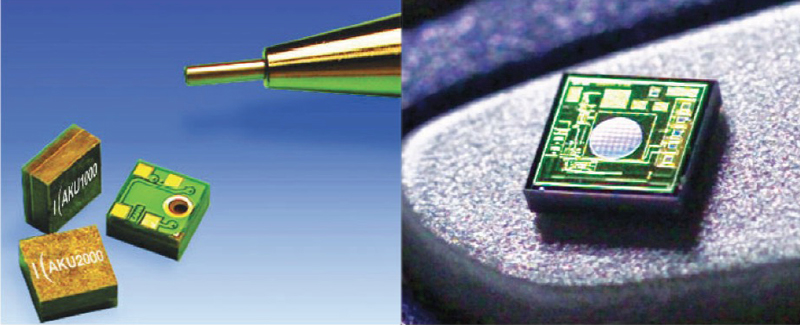
For decades, the promise of MEMS microphones was slow to be achieved, with many development teams eventually giving up. Venture capital investments in MEMS companies rarely reached successful outcomes as the companies just don’t have the patience or staying power to keep pouring funds into research. There are quite a few steps in MEMS fabrication and getting high yields on every step always seemed to be another development phase away (see Photo 2). It took more than 20 years for the first billion MEMS microphones, and two years for the second billion’s production. Today, MEMS microphones are in most smartphones, tablets, and laptops.
MEMS accelerometer prototypes were successfully developed at Analog Devices, Inc. (ADI) in 1989, which has processes similar to MEMS microphones. By the mid-1990s, ADI successfully commercialized air-bag sensor accelerometers. Knowles also began development of its MEMS microphone program around the same time. In 2003, Knowles commercially launched its SiSonic MEMS microphones. Other early MEMS microphone developers included Sonion and Akustica (now part of Bosch).
MEMS first-generation microphones were noisy and could just reach 50 dBa signal/noise (S/N). But with continual improvement, the sensitivity increased and the noise floor dropped. By 2010, a few vendors reached 60 S/N, and now the best reach 70 S/N! While microelectrical engineers measure MEMS microphone success by performance specifications, perhaps a more real-world criteria is that MEMS microphones represent more than half of all microphones produced last year. Invensense, Knowles, STMicroelectronics, Akustica, AAC, Goertek, and many others have MEMS microphones in mass production. Many commodity MEMS microphone vendors are really MEMS assemblers buying the MEMS “microphone” element and the ASIC (preamp and sometimes codec), and putting this together in an IC package.
Photo 2: Akustica’s single-chip MEMS microphone establishes an industry first in small size, low cost, and high performance. It is show compared to the point of a pen (a) and in actual view (b).
Audio MEMS Beyond Microphones Expanding MEMS development from microphones to sound generators is an epic challenge as both the radiating area and the excursion are limited. Yet, MEMS devices have strong next-step development as an ideal receiver for in-canal hearing aids and implantable hearing devices (e.g., cochlear and auditory brainstem implants). These applications have very small “air pumping volume” needed for adequate acoustic output due to their close proximity to the middle ear. An even more ambitious step are in-canal earphones (in-ear monitors), which require not much more acoustic output than implantable transducers. While the industry at large has been able to digitize and shrink all other device electronics, the last remaining barrier is the speaker, which remains large, heavy, bulky, and very analog.
An actual commercial MEMS speaker is not yet ready, but I wrote this article while I was in Israel in mid-February. At the time, Audio Pixels had succeeded in reaching the third phase of a four-part commercialization program for the MEMS loudspeaker, including functional prototypes. Audio Pixels can now focus on advancing aspects related to mass production and commercialization of MEMS loudspeakers.
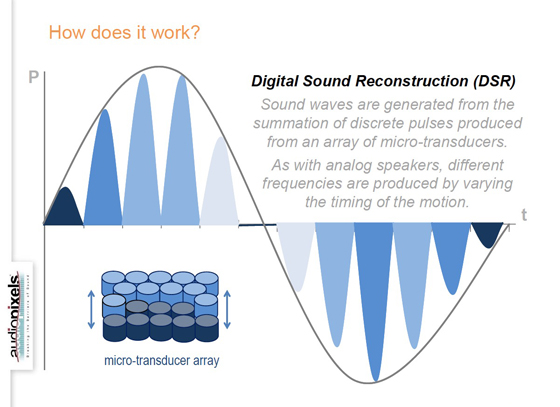
Figure 1: This diagram shows Audio Pixels’ digital sound reconstruction (DSR) methodology.
Reality Check Could MEMS loudspeakers signal the end of speakers as we know them? When MEMS speakers are viable commercial products, what might be the impact on the speaker industry, practical applications, projected unit costs, and acoustical strengths and weaknesses?
For decades, MEMS microphones were all show and no go. Yet in the last few years, they have come to dominate the mobile audio device market. On the other hand, ATCO’s hypersonic array speaker was also going to take over—but that was more of a stock market exercise—and today, it is only a boutique application. NXT was also supposed to bring the “end of the world for existing speaker technology,” but now this flat-panel topology has earned only a tiny market share. The Tymphany linear array transducers (LATs) of a few years ago is another example of a different path to sound reproduction. Currently, Tymphany is successfully producing conventional but well-executed speaker designs and no longer offers LATs. With these past “not quite game changers” still fresh in our memories, how might MEMS speakers fit into the speaker industry? It is clear that speakers are going to be a tough application for MEMS technology as speakers need piston area and excursion to move air. One of the first attempts of a MEMS “speaker on a chip” was in 2002, which featured individual addressing of the micro-diaphragms, a mechanism similar to Texas Instruments’ digital light processing (DLP) used for video projectors. Ten years ago at the height of the DLP era, Texas Instruments was the one of the largest MEMS manufacturers.
Another early effort took place at the MEMS Laboratory, Department of Electrical and Computer Engineering, Carnegie Mellon University in Pittsburg, PA. This microspeaker array used 256 elements of 200 × 200 μm each. Marginally operational, it could reach only low SPL due to the small amplitude excursion of 10 μm. Other limitations were the low 8-kHz sampling rate, a very low SNR, and an asymmetric impulse response. So, it seems the most promising MEMS speaker technology will come from Audio Pixels. The company has pursued an entirely new technique to directly generate sound waves from a digital audio stream.
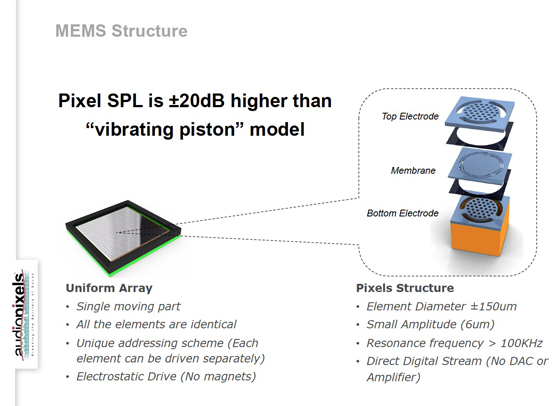
Figure 2: Here is a cutaway diagram of a proposed Audio Pixels digital MEMS loudspeaker.
Audio Pixels holds innovative patents in the fields of electromechanical structures, pressure generation, acoustic wave generation, and control, signal processing, and packaging. Its silicon chip can be used either as a standalone speaker or cascaded in any multiples of the same chip to achieve required performance specifications. This modular paradigm is comparable to “parametric speakers” such as phased arrays or using more transducers for increasing the dynamic range.
Audio Pixels’ technique is called Digital Sound Reconstruction (DSR) (see Figure 1). DSR is based on a theory introduced by Homer Dudley at Bell Labs in the late 1930s. The original project at Bell Labs was a secure “digital” speech vocoder for military communications and the “digital speaker” reconstructed the speech on the receiving end. The desired sound wave is generated from the summation of discrete pulses that are produced from an array of pressure generating elements or microtransducers (see Figure 2).
Unlike analog speakers, mini-speakers do not require a large dynamic range. In Audio Pixels’ design, an array of identical elements is used, all fine-tuned to a particular frequency. As with analog speakers, different frequencies are produced by varying the timing of the motion. There is no need for external DACs, and these transducers could have higher energy efficiency than existing speaker topologies, potentially lower harmonic distortion, and improved flatness (with simple EQ).
Yuval Cohen, Audio Pixels’ CTO, stated that “the MEMS-based Digital Sound Reconstruction platform enables the market for audio speakers to follow the evolution of the video display market from large, heavy analog tube-based monitors to the digital flat-panel displays of today. Driving the rationale for change in audio speakers is the ever-increasing demand for smaller, thinner, clearer sounding, more power-efficient speakers.” While actual commercial MEMS speakers might not be available too soon, the technology is on the path to commercialization. Functional prototypes have been demonstrated and Audio Pixels is in partnership with Sony as one of its MEMS foundry partners and ICsense for the ASIC.
Article originally published in Voice Coil, May 2015.
ABOUT MIKE KLASCO
Mike Klasco is the president of Menlo Scientific, an audio consulting firm for the loudspeaker industry, located in Richmond, CA. He is a graduate from New York University, with post graduate work in signal processing, and he holds multiple patents licensed or assigned. For the past 35 years, since founding Menlo Scientific, he has worked on product development, design and technical support, liaison between suppliers and manufacturing facilities, sourcing guidance, and certification for a large number of companies. Mike specializes in materials and fabrication techniques to enhance audio performance, has over 500 articles published in audio magazines and technical journals, and to this day continues to be a regular contributor for audioXpress and Voice Coil magazines. He presented papers at the Acoustical Society of America, held positions as Session Organizer for the Audio Engineering Society, Chairman of the Committee on Acoustics, and is an AES Life Member.
Back in 2005, I wrote about how the use of the Long-Range Acoustic Device (LRAD) was used to repel Somali pirates who were attacking a cruise ship. Sonic weapons are deployed by the military and described as non-lethal, although that may not be true depending upon the amount of time of the recipient is exposed. These sound cannons have been in use by the military and have also been used by local city police forces as well. These devices can project a voice or recording up to three hundred yards as well as incapacitating a person with excruciating levels of audio signal (about 160 dB at full force). These cannons can also immobilize an unlucky victim in a more visceral way with lower frequencies. In fact, New York City has been sued by protesters, journalists and bystanders who objected to the sound cannon’s use as excessive force, while in Pittsburgh, a bystander suffered permanent hearing loss from an LRAD attack in 2009 and was awarded $72,000. The use of LRADs has also been associated with dizziness and migraines for those who have been exposed.
‡‡ I Hear Voices…
As a communications system, LRAD has been used by Navy destroyers to communicate with small ships at great distances by aiming it at one of the crewmembers and speaking directly to them. The Navy crewmen transmitting these focused sounds often noticed how frightened the recipient was at receiving these personal messages even after realizing that it was coming from the Navy ship. Then, not being one to pass on a devilish idea, the military brass supposedly created a new weapon that could make people believe that they were hearing voices in their heads. I say supposedly, as no one in the military is actually admitting to possessing the weapon, but there are rumors that it is being used to convince Islamic terrorists to surrender by putting the word of God into the heads.
In 2013, at the Washington Navy Yard, Navy reservist Aaron Alexis went on a spree and killed 12 people before being killed in a shootout with police. Apparently, before the rampage, he had complained to friends about hearing voices and receiving vibrations from a microwave machine. It seems that “hearing voices” is a common thread running through the psychology of serial killers, but the fact that this event took place on a military base and a microwave machine was mentioned makes one wonder. During World War II, there were reports by those working near radar transponders of hearing clicks and even speech directly inside their heads. In 1961, neuroscientist Allan H. Frey published his “Human Auditory System Response to Modulated Electromagnetic Energy” in the Journal of Physiology, which described his studies and experiments with the microwave auditory effect (MAE), which has now become known as the Frey Effect.
‡‡ Brain Drain
In 1975, there were successful experiments with voice modulated microwaves, but the conclusion derived from the experiments was that this would be an impractical tool since the radiation from the high-power microwave transmission would cause brain damage. This, of course, brings to mind the recent attacks on diplomats in Cuba and China where it was concluded that the symptoms experienced by these government workers were most likely caused by directed microwave radiation. That said, the frequencies of the brain have been mapped with Beta at 12-35 Hz, which is active; Alpha from 8-12 Hz, which is very relaxed; Theta 4-8 Hz, deeply relaxed; and Delta 0.5-4 Hz, corresponding to sleep. Of course, there is no point in mapping the frequencies of the brain unless the technology can be put to use and sure enough, by beaming powerful pulses of electromagnetic radiation into the brain a scientist can roadblock or stimulate these specific circuits of the brain.
The use of ultrasonic waves to create beams of sound was being explored in the 1960s by the U.S. Navy and its Soviet counterpart, but this technology wasn’t available until the early 2000s, when “Holosonic Research Labs” — a company formed by F. Joseph Pompei of MIT — commercially released its “Audio Spotlight,” which is a narrow beam of sound that can be controlled in much the same way as the light from a spotlight. Of course, this technology seems to be similar to the technology used in LRAD, albeit in a more benign form; as in tradeshows, museums, hospitals and retail to name a few. My understanding is that if someone should walk across the beam of sound, the beam can be broken in the same way as a beam of light. Therefore, it seems that the best applications for this technology are with the spotlight speakers placed directly above the listener and not at an angle directed to the listener. Since our audio focus is directed towards delivering a band’s sound to a large audience, this pretty much removes this technology from our world of concert touring, but while we won’t be employing LRAD or Audio Spotlights, there is a new innovation that has piqued my interest.
‡‡ Feed Your Head
An Israeli company by the name of Noveto announced its newly released SoundBeamer 1.0, a commercial product that beams sound directly into the listener’s head. Well, not actually into the head, but directly to the listener’s ears without the use of headphones. It can even follow the listener as they move their head around by using a sensing module that sends 3D audio via ultrasonic waves. These ultrasonic waves create pockets surrounding the listener’s ears that only they can hear. The sound beam can also be fixed, allowing the listener to walk in and out of the beam.
‡‡ An Onstage Solution
While this commercially new sound beaming technology is being explored and developed for Augmented Reality and Virtual Reality applications, one can easily envision the day when the technology can be used in a live concert situation, replacing in ear monitors with beaming monitors. After all, the technology has been in use by the military for about 20 years, which is about the right amount of time before release for public consumption. As a multi-purpose tool, just think what a boon this could be for sound and security if a fan rushes the stage. The monitor engineer can turn the sound beam into an LRAD and incapacitate the unruly fan without disrupting the show, or in a really suave move, the engineer could hit the fan with the voice of God and threaten to smite them for their trespass if they do not immediately leave the stage.
The ISAT program is developing technologies that enable the deployment of extremely large electronically scanning antennas in space, and the metrology and calibration technologies necessary for coherent beamforming from such large antennas. These huge antennas enable the revolutionary performance required to conduct tactical sensing from space, including missions like continuous reliable tracking of surface targets.[3]
GomSpace Sweden signed a contract with Astrocast, a Swiss nanosatellites provider, to deliver a propulsion system for each of the 10 nanosatellites in the first orbital plane of the new Astrocast constellation. This will be the first propulsion system operating on a constellation of 3U cubsesats.
The contract is a follow-on order to the delivery of propulsions systems for the two precursor satellites, which will be launched this fall. The system will allow Astrocast to more rapidly deploy each satellite to its intended position and will assist in collision avoidance maneuvers.
Astrocast has been deploying nanosatellites to create a global Internet of Things (IOT) network. The order is valued at 450,000 euros and the propulsion systems will be delivered in Q4 2018 and Q1 2019.