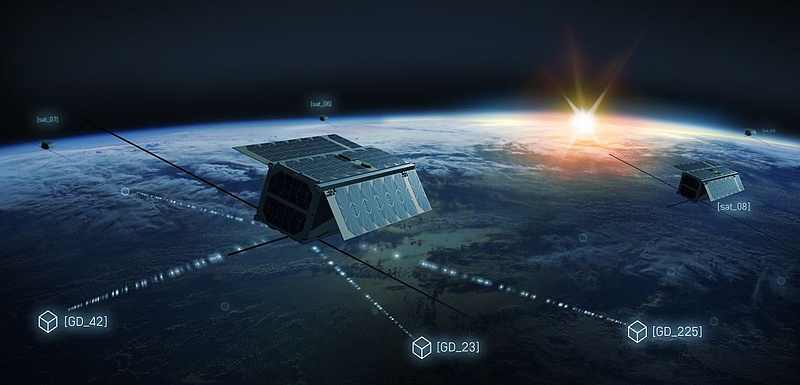
The ISAT program is developing technologies that enable the deployment of extremely large electronically scanning antennas in space, and the metrology and calibration technologies necessary for coherent beamforming from such large antennas. These huge antennas enable the revolutionary performance required to conduct tactical sensing from space, including missions like continuous reliable tracking of surface targets.[3]
GomSpace Sweden signed a contract with Astrocast, a Swiss nanosatellites provider, to deliver a propulsion system for each of the 10 nanosatellites in the first orbital plane of the new Astrocast constellation. This will be the first propulsion system operating on a constellation of 3U cubsesats.
The contract is a follow-on order to the delivery of propulsions systems for the two precursor satellites, which will be launched this fall. The system will allow Astrocast to more rapidly deploy each satellite to its intended position and will assist in collision avoidance maneuvers.
Astrocast has been deploying nanosatellites to create a global Internet of Things (IOT) network. The order is valued at 450,000 euros and the propulsion systems will be delivered in Q4 2018 and Q1 2019.
The satellites transmit ranging signals on two D-band frequencies: Link 1 (Ll ) at 1575.42 MHz and Link 2 (L2) at 1227.6 MHz. The satellite signals are transmitted using spread-spectrum techniques, employing two different ranging codes as spreading fictions, a 1.023 MHz coarse/acquisition code (C/A-code) on L1 and a 10.23 MHz precision code (P-code) on both L1 and L2. Either the C/A-code or the P-code can be used to determine the range between the satellite and the user, however, the P-code is normally encrypted and available only to authorized users. When encrypted, the P-code is known as the Y-code. A 50 Hz navigation message is superimposed on both the P(Y) -code and the C/A-code. The navigation message includes satellite clock-bias data, satellite ephemeris (precise orbital) data for the transmitting satellite, ionospheric signal-propagation correction data, and satellite almanac (coarse orbital) data for the entire constellation. Refer to paragraph 1.4 for additional details regarding the ranging codes and navigation message.
B.E.A.S.T. which
stands for Battle Engagement Arena Simulation and Tracking
in eurpoe brussel
In Belgium (Brussels) is the BEAST (Beast) - Biometric Encryption And Satellite Tracking, 'Mark of the Beast'
MARK = MARC = M.A.R.C.C. = Multiple Automated Readout Computer Chip
BEAST = B.E.A.S.T. = Battle Engagement Area Simulation and Tracking
The military super computers, since the
1970s, go by the acronym B.E.A.S.T. which stands for Battle Engagement Arena
Simulation and Tracking. GI's are now tagged with a tracking chip called the
Multiple Automated Readout Computer Chip (MARCC).
10. Military
computers developed at AREA 51, are said to be using HUMAN DNA, specifically
brain cells stretched across the computer chips, making them as fast as the
speed of thought.
1) "The US Government has a computer named B.E.A.S.T. (Battle Engagement Area Simulation and Tracking), developed out of Area 51. It uplinks to a satellite using GPS. They power a Diode in a computer chip called M.A.R.C. (Multiple Automated Readout Chip), which is best placed in the hand or forehead because of lowest body temperature. I don't put any stock in the view that this is from prophesy, however, this is an interesting choice of terms used by our government for such a system.
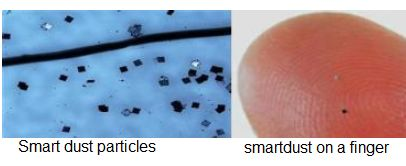
A new camera/sensor, the size of a grain of salt, has shaken up the technology world. These miniature cameras can operate wirelessly and are small enough to inject into the human body. Watch out for Smart Dust.
Sounds like something from a movie, right? Well this invention is very real and is changing the way we research and observe.
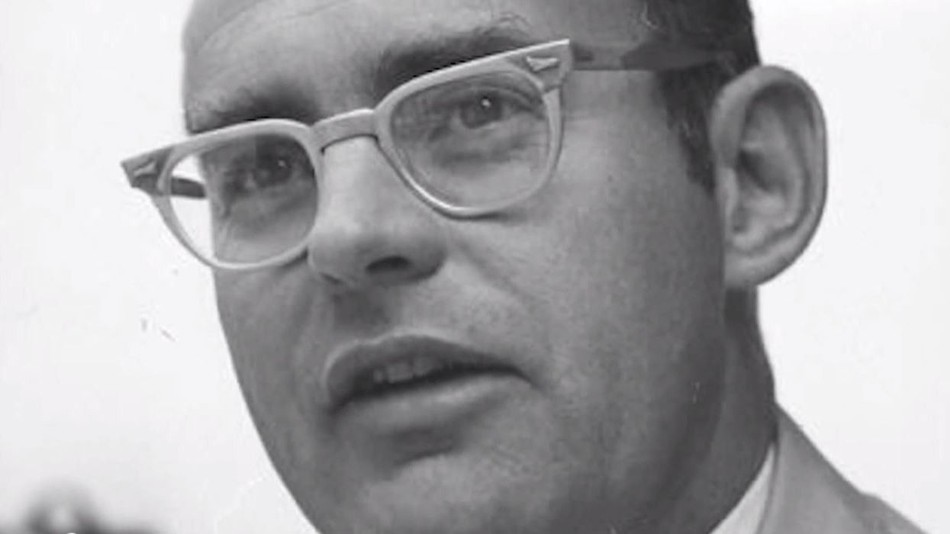
The concept has been tossed around, from science studies to science fiction novels. While the invention of the device started in the mid 1990s, it was Moore’s Law that began this discussion. Moore’s Law dates back to 1965, where Gordon Moore (founder of Intel) predicted that the number of components that could fit on a single chip could double every 2 years. This prompted the idea of miniaturizing technology and has created huge change in the industry. Soon, gadgets are becoming smaller and more powerful.
In the early 1990s, talks of the technology and its uses came from a workshop at RAND, with a heavy focus on military applications. The concept was heavily influenced by work at the UCLA and the University of Michigan.
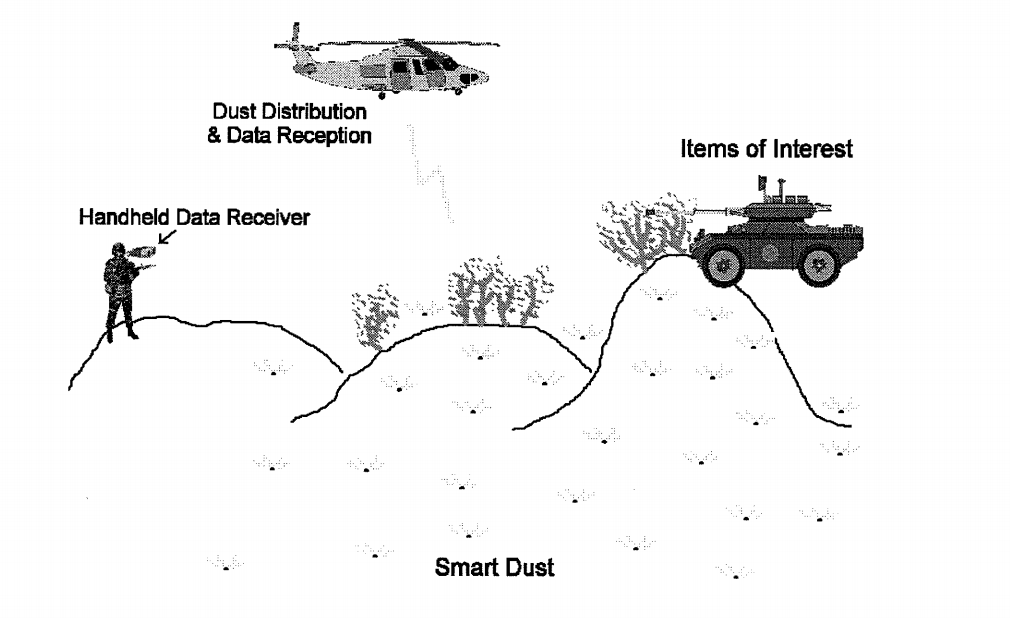
In the mid 1990s, Kristofer S. J. Pister created a research proposal for Smart Dust, with Joe Kahn and Bernhard Boser from the University of California, Berkeley. The project was soon approved for funding, and secured Dr. Pister’s status as the inventor of Smart Dust. In 2001, the American military has conducted a surveillance test with these devices. Having calculated the speed and direction of 142 military vehicles, the test was deemed a huge success.
Eventually, Dr. Pister founded Dust Networks in 2004 (acquired by Linear Networks in 2011). The company has shifted its attention to commercial applications. Soon, other companies took notice due to its work in asset, environment and health monitoring. In supermarkets, automation is now becoming a reality, with promises to track inventory movement and reduce waits at checkouts with a reader that tracks everything in a shopping cart and provides bill to customers. As these sensors grow and become more intelligent, they start to adopt more tasks, like detecting humidity and temperature.
The Future of Smart Dust
Thanks to Gordon Moore and Dr. Pister, more companies are adopting this technology and are discovering new ways to utilize it.
Hewlett-Packard (HP) founded the Central Nervous System of the Earth (CeNSE) in 2010, which aims to launch billions of nanoscale sensors around to world to observe and gather data on the physical environment. The hopes is to improve the way humans and businesses manage environmental, biological and structural changes.
More and more talks of incorporating the technology with medical practices are popping up. There has been talks in integrating Smart Dust with human augmentation, through brain-computer interfaces (BCI). Elon Musk launched Neuralink in 2016, with hopes to treat brain disease and eventually lead to human enhancement.
The possibilities are endless with technology. While some might think these ideas are only possible in science fiction films, more and more companies are proving the wrong. Who knows? Next year, we might in line for brain implants or nanoscale home surveillance.
Smartdust[1] is a system of many tiny microelectromechanical systems (MEMS) such as sensors, robots, or other devices, that can detect, for example, light, temperature, vibration, magnetism, or chemicals. They are usually operated on a computer networkwirelessly and are distributed over some area to perform tasks, usually sensing through radio-frequency identification. Without an antenna of much greater size the range of tiny smart dust communication devices is measured in a few millimeters and they may be vulnerable to electromagnetic disablement and destruction by microwave exposure.
The concepts for Smart Dust emerged from a workshop at RAND in 1992 and a series of DARPA ISAT studies in the mid-1990s due to the potential military applications of the technology.[2] The work was strongly influenced by work at UCLA and the University of Michigan during that period, as well as science fiction authors Stanislaw Lem (in novels The Invincible in 1964 and Peace on Earth in 1985), Neal Stephenson and Vernor Vinge. The first public presentation of the concept by that name was at the American Vacuum Societymeeting in Anaheim in 1996.
A Smart Dust research proposal[3] was presented to DARPA written by Kristofer S. J. Pister, Joe Kahn, and Bernhard Boser, all from the University of California, Berkeley, in 1997. The proposal, to build wireless sensor nodes with a volume of one cubic millimeter, was selected for funding in 1998. The project led to a working mote smaller than a grain of rice,[4] and larger "COTS Dust" devices kicked off the TinyOS effort at Berkeley.
The concept was later expanded upon by Kris Pister in 2001.[5] A recent review discusses various techniques to take smartdust in sensor networks beyond millimeter dimensions to the micrometre level.[6]
The Ultra-Fast Systems component of the Nanoelectronics Research Centre at the University of Glasgow is a founding member of a large international consortium which is developing a related concept: smart specks.[7]
Smart Dust entered the Gartner Hype Cycle on Emerging Technologies in 2003,[8] and returned in 2013 as the most speculative entrant.[9]